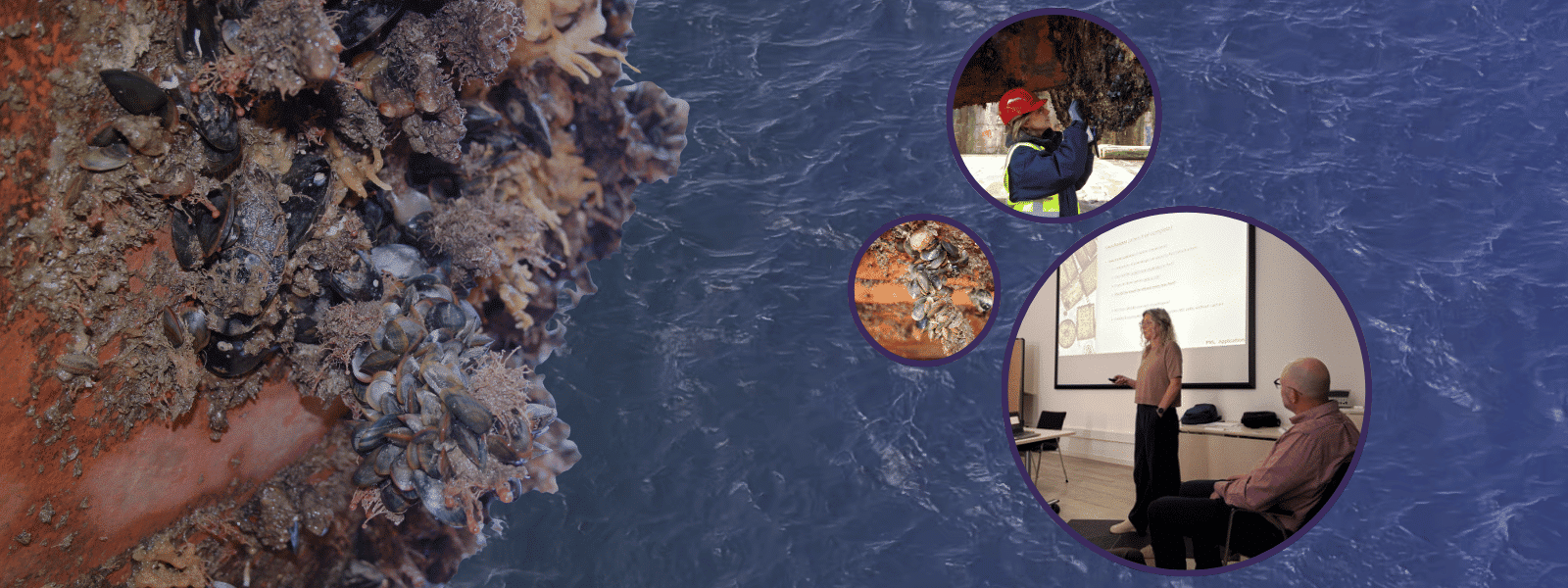
Anna Yunnie and Lloyd Rees presented current work on evaluating the risk of introducing new pathogens during proactive cleaning at PortPIC 2026 in Mülheim, Germany, representing PML Applications’ Centre for Marine Biofouling and Corrosion.
Anna talked about a combined field and laboratory method to evaluate the risk of biofilms removed during proactive cleaning, developed specifically for a project request from Norwegian-based Jotun – one of the world’s leading antifoul coating manufacturers and manufacturer of the HullSkater proactive cleaning system.
Managing biofouling is key to reducing the risk of transferring non-native species, both macrofouling and microfouling (including pathogens), between ports. These species have the potential to negatively impact the environment, the economy or human health.
Currently, standard reactive cleaning methods are designed to remove developed macrofouling, which is already accepted as a potential biosecurity risk, with previous studies showing that species such as Pacific oysters can be highly invasive when introduced to new areas. Therefore, removing biofouling at the biofilm stage, before macrofouling has even had a chance to develop, vastly improves biosecurity.
Our new in-depth study takes the science a step further by examining the impact of removing biofilms on local ecosystems to establish whether microfouling poses a similar biosecurity risk. Our robust scientific study, commissioned by Jotun, aims to establish whether precautions and regulations for biofilm removal are necessary for biosecurity.
Previous studies established that pathogens can and do live in ship’s biofilms, but the question is whether the release during in-water cleaning poses a potential risk of introducing new species to the area or to overwhelm them. To deepen understanding, PML Applications and Jotun’s study investigates the presence of pathogens not only on the ship’s hull and from the release into the water column during cleaning but also the existing presence and species assemblage on surrounding infrastructure and on the hull of a local vessel with similar antifouling treatment. This approach provides a broad overview of pathogen occurrence already in the area in comparison to species released during a clean with the Jotun “HullSkater”, to assess any additional risk posed by the cleaning of incoming vessels through the introduction of new species, or large amounts of pathogens to the area.
This study takes into account that any testing of pathogens in the biofilm of a vessel should thoroughly investigate biofilms formed on comparable local substrates to test for their presence and abundance. Modern methods, including eDNA, are sometimes fallible, and limitations are also understood in this context. Robust scientific design and methods, along with specialist interpretation of data, are crucial to inform the whole story, not just a partial telling.
Studies such as this are a step towards informing biosecurity legislation and ensuring future legislation is grounded in robust science, taking all potential reservoirs into account. The development of upcoming regulations and legislation must be backed by facts and evidential data. As we near the time when more regulations are likely to come into effect, it is vital to provide science-backed evidence to inform appropriate biosecurity measures.
Anna said –
“This is a challenging piece of work with complex logistics, engineering, and laboratory work to overcome, but, as ever, Lloyd Rees (engineering) and Tristan Biggs (laboratory) have risen to the task, and we have a plan that we believe will provide the client and the industry with robust methods and data to inform decisions on capture requirements for proactive cleaning.”
PML Applications’ Biosecurity Services
PML Applications’ Centre for Marine Biofouling and Corrosion is backed by a delivery team of applied research scientists who work to deliver accurate, impartial data based on robust testing of biofouling, antifouling coatings and in-water cleaning technology. Led by centre manager Anna Yunnie, who brings nearly two decades of biofouling and biosecurity experience, PML Applications is excited to conduct and present this study.
Find out more about the services available from PML Applications’ Centre for Marine Biofouling and Corrosion or contact Anna at anyu@pml.ac.uk to enquire about developing a project.
PortPIC 2026
This is Anna and Lloyd’s fourth time attending PortPIC. Due to the niche topics covered at PortPIC, it is a valuable opportunity to learn about new projects and developments in the in-water cleaning industry, with time set aside for important discussions and networking.
PortPIC 2026 marks the 7th In-Port Inspection & Cleaning Conference, bringing together professionals from a range of sectors within the industry to discuss topics such as aquatic invasive organisms, diver operations in ports, next-generation antifouling technologies, operators’ perspectives on cleaning, performance-based cleaning, regulations and guidelines, and robotic cleaning and inspection.
Lloyd said –
“We always look forward to attending PortPIC to exchange ideas and hear the most recent updates. It is such a key event for making new connections across the industry and bringing together familiar faces. The event was well attended and sparked lots of interesting discussions across sectors. We’d love to see even more involvement from divers and ports – those who already attend help us to understand the needs and problems so it would be great to hear from more voices about how PML Applications can help. Thank you to the organisers of PortPIC for hosting another successful event that we really enjoyed participating in.”
PortPIC | 16th-17th September 2026 | Mülheim, Germany