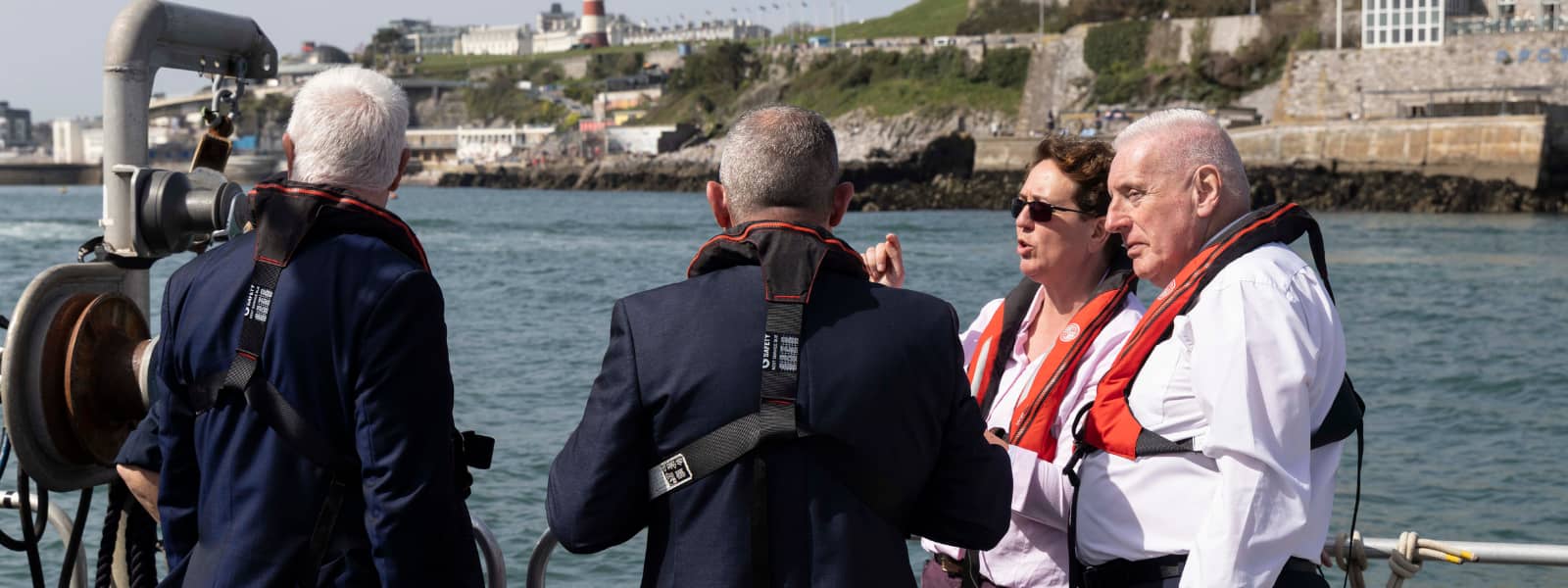
PML Applications welcomes the UK government’s £50 million defence growth deal to boost Plymouth and South West maritime business innovation and the development of surface and subsurface maritime drones, marking a major investment into marine science and technology.
Image: Minister of State, Lord Coaker, pictured at Turnchapel Wharf as part of the official launch of the Plymouth Defence Growth Deal.
The momentum of growth following Plymouth being named as the National Centre for Marine Autonomy continues, and for organisations such as PML Applications and Plymouth Marine Laboratory (PML) these new investments bring opportunities for collaboration and innovation, bringing together research, industry and government to facilitate real-world marine autonomy trials and develop maritime technology.
The defence investment will also support technical training facilities, start-up and marine autonomy businesses, and job creation, which, in turn strengthens Plymouth’s autonomous technology capabilities and supports the progress of projects such as PML-led, Smart Sound Plymouth, the UK’s leading testing facility for marine autonomy, uncrewed systems, and advanced ocean technologies.
Professor James Fishwick, Smart Sound Plymouth Head of Innovation, and Head of Operations and Technology, Western Channel Observatory, said:
“Plymouth is fast becoming a global centre for marine autonomy, and Smart Sound Plymouth is at the heart of that. This investment will help unlock new opportunities to test, scale and deploy cutting-edge technologies – accelerating innovation that benefits both defence and the marine environment.”

Image: PML’s Professor James Fishwick pictured at the official launch of the Plymouth Defence Growth Deal.
With access to authorised water space, Smart Sound Plymouth is developing processes for testing maritime technologies to be able to support businesses from concept to market-readiness. Smart Sound Plymouth is backed by decades of expertise in a range of sectors such as defence, offshore industries and marine science. Led by PML, Smart Sound Plymouth’s work not only supports development of maritime technology but also environmental monitoring and data-driven decision making at sea.
PML Applications’ Sam Fawcett, Manager of the Centre for Coastal Technologies and Smart Sound Plymouth Head of Commercial, said:
“At PML Applications, we’re focused on helping clients move from concept to deployment as efficiently as possible. This investment strengthens the infrastructure and capability we have here in Plymouth – making it easier to test, validate and operate new marine technologies safely in real-world conditions.”
Smart Sound Plymouth and PML Applications support clients with autonomy services including desk-based, lab-based, and open-water. PML Applications, the commercial arm of Plymouth Marine Laboratory (PML), already has established relationships with major defence organisations, offering expertise in marine operations. PML Applications’ Centre for Coastal Technologies offers marine autonomy services, providing:
- Access to a designated and authorised testing area for autonomous vessels.
- End-to-end support for autonomous technologies, helping clients progress to operational readiness efficiently, cost-effectively, and with reduced risk.
- Experienced team specialising in deployment and marine operations.
- Commercial access to the UK’s leading marine technology testbed, Smart Sound Plymouth, alongside the facilities of the Western Channel Observatory.
- Extensive expertise and infrastructure, both onshore and offshore, enabling testing in controlled and real-world environmental conditions.
- Access to PML and Smart Sound Plymouth’s fleet of specialist vessels and testing facilities.
- Security-cleared employees for defence contract readiness.
To find out more about how we support companies with maritime technology trials, see Case Study: Open Water Trials of Dynautics’ Phantom 2 Uncrewed Underwater Vehicle Prototype.
PML Applications looks forward to seeing the development of Plymouth’s offering following the defence growth deal investment, especially within the autonomous technology sector. Not only will it boost Plymouth’s economy but it will also promote education by building opportunities for training, resulting in a workforce ready to support a rapidly growing sector.